
Blog ·
Why Skincare Ingredient Checker Apps Are Failing Sensitive Skin
If you have sensitive skin, rosacea, or eczema, you've likely experienced this scenario:
You stand in a store aisle, scan a moisturizer with a popular rating app, and see a high "safety score." Encouraged by the green light, you buy it, use it for two days, and still end up with a flare-up.
It’s a common frustration, but the issue usually isn't an unpredictable reaction. It's that most skincare rating apps are built on an oversimplified framework that doesn't align with basic dermatology or cosmetic chemistry.
Here is a breakdown of why generic ingredient scoring fails reactive skin, and what actual personalized screening requires.
The Problem with 0–100 "Safety" Scores
Most consumer skincare apps rely on a single, binary metric: a 0 to 100 rating scale that labels ingredients as strictly "good" or "bad."
While this makes for a simple user experience, human biology doesn't work in binaries.
Context matters: A natural botanical oil like lavender or citrus might receive a "100/100 Clean" rating on a popular app. Yet for someone with rosacea or compromised skin barriers, those exact natural extracts are potent sensitizers.
Toxicity vs. Sensitization: A well-studied synthetic preservative might be flagged as "toxic" by an app's algorithm due to high-dose animal studies, even though at a 0.5% concentration, it simply keeps a formula free of bacteria that would otherwise infect open eczema patches.
When an app evaluates ingredients in a vacuum, ignoring concentration, skin condition, and individual history, it creates a false sense of security.
The Business Model Conflict
To understand why ingredient apps focus on generalities rather than precision, it helps to look at how consumer software is funded.
Many free rating platforms monetize through a few specific channels:
Affiliate Links: Earning a commission when a user clicks through to buy a recommended alternative.
Brand Certifications: Selling "clean" or "approved" badges to cosmetics companies to feature on their packaging.
Engagement Features: Adding daily routines, habit trackers, and push notifications to keep users returning to the app daily.
When a platform relies on affiliate sales or brand partnerships, its primary objective shifts toward driving product discovery and transactions. Precision diagnostics for sensitive skin become a secondary priority.
What Reactive Skin Actually Requires
If you are trying to avoid specific contact allergens or flare-up triggers, evaluating a product requires a very different technical approach:
1. Chemical Derivative Mapping
Ingredients rarely appear on labels under a single, friendly name. A single common surfactant or emulsifier can exist under dozens of trade names and scientific aliases. An effective tool needs to trace the chemical parentage of an ingredient to flag hidden derivatives, rather than just matching exact text strings.
2. Personalized Risk Logic
There is no universal "safe" list. A tool must allow you to map products against your specific, known triggers; whether that's a diagnosed contact allergy to fragrance mixes, a sensitivity to specific fatty alcohols, or an intolerance to strong acids.
3. Independent Data
For ingredient evaluation to be useful, the underlying database needs to be decoupled from brand sponsorships, paid ratings, and store commissions.
Why We Built DermicIQ
We built DermicIQ to address this specific gap in the personal care space.
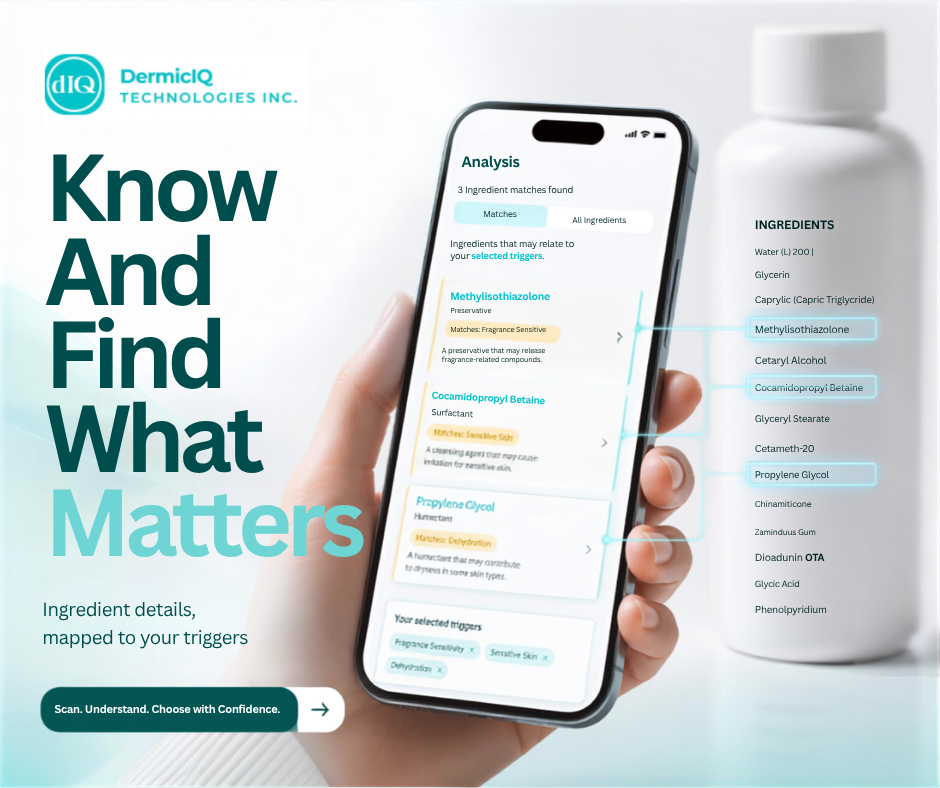
Instead of generating arbitrary safety scores or promoting routine daily steps, DermicIQ operates strictly as an ingredient parser.
Derivative Matching: Our system cross-references over 50,000 chemical aliases to highlight hidden trigger derivatives in real time.
Individualized Profiles: Rather than telling you whether a product is "clean," it tells you whether it matches your specific skin profile and known triggers.
No Brand Monetization: We do not accept paid brand listings, sell safety seals, or use affiliate links to push alternative products.
If you want to check your current products against your personal triggers without the marketing noise, you should give DermicIQ a try!
Scan your first product in under 30 seconds and take the guesswork out of personal care.