
Blog ·
Ditching Binary Judgments: Why Ingredients Aren't "Safe vs. Toxic"
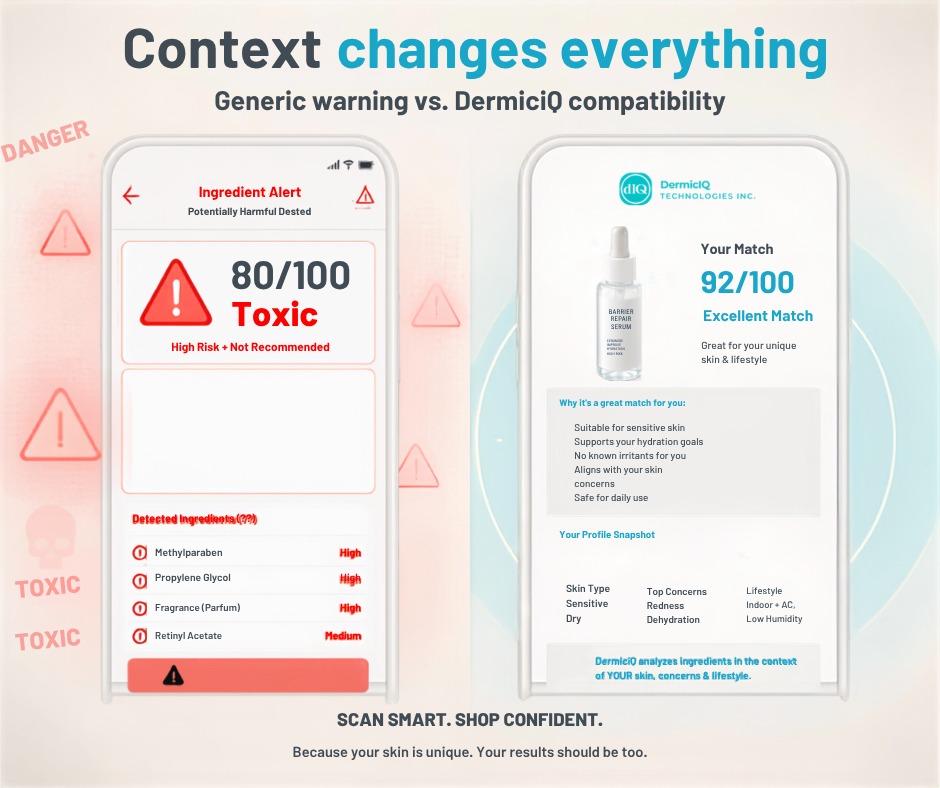
If you’ve ever opened a popular ingredient-scanning app in the middle of a Target aisle, you’ve seen it: a bright red "90/100 – TOXIC" warning pulsing on your screen because a moisturizer contains a plant oil or a common preservative.
It’s compelling. It’s dramatic. And, honestly? It’s mostly nonsense.
We’ve been conditioned by the personal care industry and well-meaning "clean beauty" platforms to believe that cosmetics exist in a black-and-white world. Ingredients are either pure, clean, and safe—or they are toxic sludges secretly poisoning your skin barrier.
It makes for great social media graphics and quick viral app downloads. But if you actually live with sensitive, reactive skin, you know the reality is far messier.
Here is why binary "Safe vs. Toxic" ratings are failing you, and what actually matters when you're trying to keep your skin calm.
The Monolith Myth: You Are Not an Average
Binary scoring systems treat human biology like a monolith. They calculate a product's safety score based on a generic, population-wide hazard scale.
The fundamental flaw? Toxicology depends on individual biology and concentration, not just presence.
Take organic coconut oil or lavender essential oil. On almost every generic scanner app, these ingredients get a glowing green, "100% Clean & Safe" stamp of approval. They’re natural! They’re botanical!
Except, if you have rosacea, lavender oil can cause an instant, burning flare-up. If you have severe contact dermatitis, coconut derivatives can trigger cystic breakouts and allergic reactions.
Conversely, an ingredient like Phenoxyethanol—a incredibly well-studied preservative that stops mold and deadly bacteria from growing in your water-based creams—often gets flagged in red as a "scary toxin." But for 98% of people with sensitive skin, a safe 0.5% concentration of a stable preservative is infinitely better than putting a moldy, unpreserved organic cream on an open eczema patch.
A generic 0–100 score doesn't know your skin. It doesn't know your triggers. It just gives you a cheap, simplified answer to a deeply complex biological question.
Fear-Mongering is Good Business (But Bad Healthcare)
Why do so many apps rely on these dramatic "red vs. green" scores? Because fear drives clicks.
When an app tells you that your favorite body wash is "toxic," your adrenaline spikes. You panic, you put the bottle back, and you look for a "clean" alternative recommended right inside the app.
What most consumers don't realize is that many rating platforms profit off this exact panic. They make their money by:
Charging brands heavy fees to earn a "Clean & Certified" badge.
Running affiliate links that take a commission every time you buy their recommended "safe" alternative.
Monetizing your fear while giving you zero actual context about cosmetic chemistry.
When a platform takes money from the very brands it rates, it isn't an independent health utility anymore. It’s a retail middleman.
Our Promise: Sovereign Neutrality
At DermicIQ, we refuse to play the fear-mongering game. We don't take money from beauty brands, we don't accept paid product placements, and we will never assign a fake "1–100 toxicity score" to a product. Your health tool should never be for sale.
What Actually Matters: Algorithmic Matchmaking
If binary safety scores are a myth, how do you actually protect your skin without needing a master's degree in organic chemistry?
It comes down to three things: Context, Derivative Mapping, and Personal Compatibility.
Instead of asking, "Is this product toxic?" the real question you should be asking is, "Is this specific chemical composition compatible with my unique biological skin barrier?"
This is the exact problem we set out to solve with DermicIQ.
How DermicIQ Replaces Fear with Precision
Rather than giving you a blanket "good or bad" grade, DermicIQ acts as a precise algorithmic matchmaker between a bottle’s raw ingredients and your specific skin profile:
No Arbitrary Numbers: We don't tell you a product is "60% dangerous." We give you a straightforward compatibility readout based on your skin history, diagnosed conditions, and personal triggers.
Uncovering Hidden Aliases: Cosmetic chemistry loves hiding triggers under chemical trade names. If you react to palm oil or coconut, our Hierarchical Derivative Engine maps over 50,000 hidden chemical synonyms—so you know if a compound was derived from your trigger, even if the label doesn't explicitly say so.
Grounded in Clinical Science: We don't build our database on internet wellness trends. Our trigger frameworks are continuously reviewed alongside clinical allergists, dermatologists, and cosmetic chemists to reflect actual contact dermatitis research.
Stop Fearing Ingredients. Start Understanding Them.
You shouldn't have to feel anxious every time you stand in the personal care aisle, wondering if a red score on a screen is lying to you.
Your skin barrier deserves better than generic rules and corporate fear tactics. It deserves personalized, clinically grounded truth.
DermicIQ is live, fully functional, and 100% free to download on iOS and Android.
Ditch the binary guessing games and see what's actually in your products:
👉 [Download DermicIQ today!] (Free Download)
Scan your first bottle in under 30 seconds and take the panic out of skincare.