
Blog ·
What Does "Hypoallergenic" Actually Mean? The Skincare Marketing Trap.
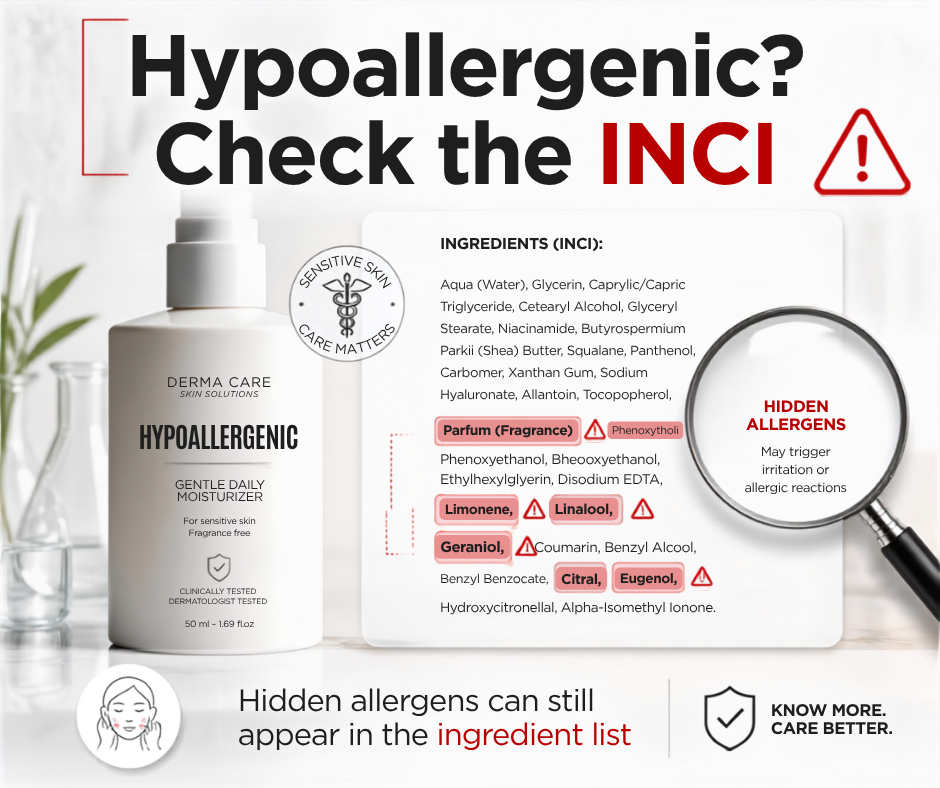
If you have ever picked up a bottle of moisturizer or body wash, seen the word "Hypoallergenic" printed across the label, and felt a tiny wave of relief, you aren't alone.
It feels like a promise. It feels like a guarantee that your skin isn't going to turn red, start itching, or break out in a flare-up two hours after applying it.
So, what does "hypoallergenic" actually mean in the skincare industry?
Legally speaking? It means absolutely nothing.
It’s not a clinical standard. It’s not an FDA seal of safety. It is a marketing term invented in the 1950s that carries zero legal weight. And if you have sensitive, reactive, or allergy-prone skin, relying on that word is one of the quickest ways to end up right back in the trial-and-error cycle.
Here is the truth behind the "hypoallergenic" label, why the law allows it, and how you can actually protect your skin without trusting empty bottle slogans.
The FDA Lawsuit You’ve Never Heard Of
Most people assume that if a brand prints "hypoallergenic" on a package, a government agency like the U.S. Food and Drug Administration (FDA) made them prove it in a lab first.
In reality, the official FDA stance on hypoallergenic cosmetics states:
"There are no Federal standards or definitions that govern the use of the term 'hypoallergenic.' The term means whatever a particular company wants it to mean." — U.S. Food & Drug Administration (FDA)
It wasn't always supposed to be this way. Back in 1974, the FDA tried to pass a law requiring cosmetic companies to run human scientific studies proving their products caused significantly fewer allergic reactions before using the label.
What happened? Major cosmetic conglomerates sued the FDA. In 1977, a U.S. Court of Appeals struck down the regulation. Ever since, brands have been free to slap "hypoallergenic" on any bottle, serum, or cream; without submitting a single shred of scientific evidence to back it up.
94% of "Safe" Skincare Contains Known Contact Allergens
If you've ever had a bad reaction to a product labeled "gentle" or "hypoallergenic," you aren't crazy; and your skin barrier isn't just being dramatic.
Allergic Contact Dermatitis (ACD) affects up to 20% of the general population and costs over $1.5 billion in medical expenses every year in the United States alone. Yet the products sold to "fix" sensitive skin are often packed with the exact compounds causing the problem.
A study conducted by researchers at Stanford Medicine evaluated over 1,700 personal care products marketed as natural or gentle. The findings were staggering:
94.2% of the products contained at least one known contact allergen.
89.5% contained ingredients from the top 100 most clinically prevalent skin allergens (including hidden fragrance constituents and botanical extracts).
A brand can formulate a lotion with known sensitizers, like linalool, essential oil derivatives, or specific fatty alcohols; and still call it "hypoallergenic" simply because they believe it’s less likely to cause a reaction than a heavy industrial cleanser.
Our Moat: Sovereign Neutrality
At DermicIQ, we don't care about the marketing words on the front of the bottle. We don't take brand sponsorships, we don't host paid product placements, and we never let companies buy "safe" ratings. We only care about what’s actually inside the formula.
Why Reading Labels Still Isn't Enough
"Okay," you might think, "I'll just ignore the marketing and read the ingredient list on the back."
That’s a great first step; until you run into the INCI Black Box.
International Nomenclature of Cosmetic Ingredients (INCI) names are written in a mix of Latin, chemical shorthand, and trade aliases. Even worse, triggers hide inside derivative families.
If your skin reacts to coconut or palm derivatives, you won't just see the word "coconut" on the label. It hides under 30+ scientific aliases like Cocamidopropyl Betaine, Lauric Acid, Cetearyl Alcohol, or Caprylic Triglyceride.
Unless you carry a degree in organic chemistry in your back pocket, catching every hidden alias in a 40-ingredient block of tiny print while standing in a store aisle is nearly impossible.
How DermicIQ Replaces Marketing Buzzwords with Precision
You shouldn't have to play detective every time you want to buy a face wash. We built DermicIQ to bridge the gap between clinical dermatology and your everyday shopping routine.
Instead of trusting vague terms like "hypoallergenic," DermicIQ gives you an instant, science-backed truth check:
Real-Time Derivative Mapping: Our engine parses over 50,000 INCI synonyms and chemical derivative trees in milliseconds. If an ingredient is derived from a trigger you react to, DermicIQ flags it immediately; even if it's disguised under a complex trade name.
Personalized to Your Biology: We don't give generic 0–100 safety scores. We evaluate a product's chemical breakdown directly against your specific skin conditions and custom triggers.
Grounded in Contact Dermatitis Research: Our database is built alongside clinical allergists, dermatologists, and cosmetic chemists, not internet wellness trends.
Stop Trusting Slogans. Start Knowing What's Inside.
The personal care aisle is full of traps, but you don't have to keep gambling your money or your skin barrier on marketing terms that have no legal meaning.
DermicIQ is fully functional, live, and 100% free to download on iOS and Android.
Ready to stop guessing and decode what's actually in your products?
👉 [Download DermicIQ today] (Free Download)
Scan your first product in under 30 seconds and take the guesswork out of skincare.